

The Secret Skill That Helps You Win in High-Stakes Rooms

Vidya Raman • December 9, 2025

Early in my project management career pivot, I led a meeting to align the team on the next steps for a project. Nothing controversial. It already had broad consensus. It should have been simple.


What should have been a quick alignment turned into an unanticipated power play. One functional lead hijacked my well-considered agenda to push his own priorities, and another raised her voice to defend her turf. The atmosphere shifted quickly from collaborative to combative.


I tried to steer the conversation back, but my pleas and mild directives were largely ignored. My voice and confidence faltered, and I watched the room slip away. I was no longer leading my meeting. My manager was silently observing me from across the table, and I could feel myself coming undone. For days after that, I replayed the moment, wondering how I had allowed both my meeting and my mind to be hijacked. I had always thought of myself as calm under pressure, but that day taught me a humbling lesson.


I realized that if I ever wanted to truly lead the room, I had to steady myself first, especially when the pressure was high.


What I See in My Career Coaching Practice

The most common challenge my career advancement clients face isn’t capability or productivity. It’s staying composed and strategic while navigating egos, politics, and high-pressure rooms that drain their focus and chip away at their confidence.


It’s not the workload that burns them out. It’s the emotional weight of navigating people. The politics. The passive-aggressive emails. The meetings that feel more like battlegrounds than brainstorming sessions. The colleague who deletes your name from the deck and then compliments your outfit in the hallway like nothing ever happened.


𝐓𝐡𝐞 𝐫𝐞𝐚𝐥 𝐝𝐫𝐚𝐢𝐧 𝐢𝐬𝐧’𝐭 𝐭𝐡𝐞 𝐰𝐨𝐫𝐤. 𝐈𝐭’𝐬 𝐭𝐡𝐞 𝐭𝐢𝐦𝐞 𝐚𝐧𝐝 𝐞𝐧𝐞𝐫𝐠𝐲 𝐬𝐩𝐞𝐧𝐭 𝐫𝐞𝐩𝐥𝐚𝐲𝐢𝐧𝐠 𝐭𝐨𝐱𝐢𝐜 𝐢𝐧𝐭𝐞𝐫𝐚𝐜𝐭𝐢𝐨𝐧𝐬 𝐢𝐧𝐬𝐭𝐞𝐚𝐝 𝐨𝐟 𝐝𝐨𝐢𝐧𝐠 𝐭𝐡𝐞 𝐰𝐨𝐫𝐤 𝐭𝐡𝐚𝐭 𝐚𝐜𝐭𝐮𝐚𝐥𝐥𝐲 𝐦𝐚𝐭𝐭𝐞𝐫𝐬.


Respond, Don’t React

Viktor Frankl said it best: between stimulus and response, there is a space. Use that space wisely. Steadiness lives there. It’s where you pause, choose your response, and protect your power. The more you practice it, the more influence you gain without raising your voice or losing your cool.


When you're grounded, it's easier to stay aligned with your goals, your values, and the bigger picture. Steadiness gives you emotional clarity. It sharpens your thinking. It helps you focus on what truly matters, instead of spending your day mentally defending yourself or bracing for the next outburst.


Lead yourself first, and others will trust you to lead them too.


Daily Habits That Build Steadiness

These are the practices I share with my clients and use in my own life.


1. Pause before your day begins Before checking your emails, check in with yourself. Are you already feeling tense, angry, or overwhelmed? Don’t ignore it. Write it down. Journaling your state of mind helps lighten the mental load and gives your brain space to reset.

Then ask yourself, “How do I want to show up today?” Not just what you want to do, but who you want to be. Maybe clear, calm, and curious. I used a simple daily chant to anchor myself during my corporate days: Calm and Cheerful. It shaped my disposition and helped me manage perceptions at work.


2. Zoom out Use the weekends to step back and reconnect with the bigger picture. What do you really want from your work and your life? Ask yourself a series of “Why” questions. Keep digging. You may realize that what you truly want is to grow, lead with purpose, and win the long game.

That kind of clarity takes time. It may take a few weekends of honest reflection. But the more you zoom out, the easier it becomes to lose the small battles and still win the war. It helps you rise above daily drama and stay focused on what actually moves you forward. Consciously reduce the stakes at work.


3. Shrink the trigger Same situation, different day. When you catch yourself reacting to a familiar stressor such as a certain tone, a difficult teammate, or a recurring issue, pause and reframe it. Say to yourself, “This is just a rerun, not a crisis.” You already know how it plays out. Don’t waste fresh energy on old drama.


Grace Under Pressure

Real power isn't about being the loudest voice in the room. It's about being the most grounded. Reduce the stakes by not overidentifying with your role and job description. You are not your job. Your job is what you do, not who you are. Grace under pressure is built through daily habits.


When you lead with steadiness, people trust you more. You protect your energy and focus on what actually moves the needle.


Why Waste Energy on Someone You’ll Forget?

You’ve likely forgotten the names of past energy vampires—the ones who drained you in old jobs but no longer matter. So why obsess over people who will play little to no role in your future?


I recently ran into someone just like that at a local restaurant. Years ago, he regularly undermined me and erased my contributions. As I sat down, I whispered to my husband, “That’s the guy who tortured me at work.” Then I laughed at the realization that I couldn’t remember his name. I had to search LinkedIn by company just to place him.


Why give that much mental space to someone who ends up being irrelevant?


Ask yourself: Who are you letting live rent-free in your head, and what might open up if you cleared that space?

The path to career advancement and real influence starts by reclaiming your focus. Let go of what no longer deserves space, and steady yourself for what’s next. Be that Grace Under Pressure.


May you lead with presence, protect your energy, and rise with calm strength.

Vidya Raman


Career Growth - Professional Growth - Career Advancement - Communication Skills - Presentation Mastery - Interview Skills




By Vidya Raman December 10, 2025
We all want to fulfill our potential and achieve our goals. Who doesn’t, right? But along our journey, we often hit roadblocks and fall short of our targets. Why? It could be due to situational factors or because we unknowingly self-sabotage. The latter is more common than you would think. When we make decisions, especially in pivotal moments like speaking up in an important strategic conversation at work, expressing the value we bring, or asking for a raise, we stay with what's comfortable instead of embracing the uncomfortable. Often, we are so conditioned for safety that our choice does not even register as a fear response. This invisible handcuff is a distant cousin of the obvious in-your-face ‘FEAR’. The sad truth is that the more we go with playing safe, we limit our growth and success. Yes, at times our fears are well-founded, and to gauge that accurately we have to develop our capacity to discern and differentiate between the real and the imagined. Never forget, “Everything you want is on the other side of fear.” – Jack Canfield Let’s consider the most common invisible fear response. Loss Aversion It is a psychological bias where people tend to feel the pain of losing something more intensely than the pleasure of gaining the same thing. We fear losing the familiar and exaggerate the impact of the loss compared to the potential for real gain with the unfamiliar. This self-sabotaging behavior leads us to choose inaction, sticking with what we know, and avoiding risks. When in the grip of this bias, we ignore the steep price of inaction. And, for that, we pay dearly and sacrifice our potential. Before making an important decision, ask yourself, 'Have I considered the cost of inaction?' Not acting often has a bigger price tag. It keeps us from reaching our goals. Ask yourself: Is this fear of the unfamiliar rational? Write it down, analyze it, and list the pros and cons. By doing so, you can make more objective decisions and take steps toward significant achievements. I hope you enjoy my short-form YouTube video on this subject below. I recall the first Toastmasters meeting where I was called to speak on stage. I crashed and burned because all I wanted to do was impress and hold on to my brand as a successful professional in the company. I wanted safety and did not want to risk failure. Fail, I did. Looking back, I am so glad I failed at that first attempt because going with the uncomfortable is what helped me realize my full potential. I am now living my dream as a professional speaker after a long corporate career. I shared this story not to impress you but to impress upon you to step outside your comfort zone and enable you to write your own success story. If you have a story, please share it in the comments to help inspire others. Moving on, it’s bad enough that we are plagued by loss aversion during pivotal moments. According to Daniel Kahneman, Nobel Prize winner and grandfather of behavioral economics, we also regularly contend with three other fear-based biases, Status Quo Bias, Sunk Cost Fallacy, and Negativity Bias. The status quo bias makes individuals prefer staying the same over change. The sunk cost fallacy leads people to continue investing in a decision due to past investments rather than future benefits. Negativity bias causes people to focus more on negative experiences or information, increasing fear responses as the brain is wired to react more strongly to potential threats. When your fear appears to be well-founded Sometimes fear responses appear to be well-founded, such as fear of repercussions in an unhealthy or toxic work environment. In such situations staying silent may help you get by but is it helping you become successful? Questions to ask yourself: · Am I taking things too personally? Is there concrete evidence to support my feelings? · How might others view this situation? · What could be the other person's intent? · Why am I feeling this way? Identify the root cause of your emotions—fear, insecurity, past experiences, etc. Conclusion The next time you’re at a decision-making moment, recognize when fear is holding you back and take an objective look at your decision. By doing so, you’ll not only gain career momentum but also contribute to a more dynamic and successful workplace. A win-win all around! Don't forget to like, comment, and subscribe if you find value in this newsletter and YouTube video. And share it with anyone who needs a little push to step out of their comfort zone. Stay Bold, Stay Brave, and Achieve Greatness Warm regards, Vidya Raman Motivational Speaker, Coach, Author, and ex-Corporate Leader
By Vidya Raman December 10, 2025
The simplest habit you can adopt to immediately raise your “building rapport” score is acknowledging someone by saying their name in group meetings. Those who do this regularly know the big impact it has on their reach, influence, and impact. Of course, when overused, it can backfire, and you may be perceived as inauthentic. Calling on someone by their name in a group setting can encourage participation and engagement. It makes individuals feel more included and integral to the conversation. Multiple studies have shown that small gestures of acknowledgment, such as saying someone's name, can make people feel more connected and less socially isolated. This is particularly useful for leaders and facilitators who want to ensure active involvement from all participants. When I first moved to America in the late eighties, a friendly nod from a stranger across the street helped me feel seen. And on the opposite end, I have also experienced the pain of “feeling invisible” at times in the very places I worked. Most of us have experienced that to varying extents. Last year, I had a coaching client share a story of a senior leader, in her direct skip-level hierarchy, sharing an elevator ride without a nod of acknowledgment. That left a scar. It's well-known that when people feel seen, their mood is immediately lifted, and they pass it on. It’s contagious. That feeling of social connectedness can do wonders for employee engagement and personal well-being. Our name is a core part of who we are. Hearing our name triggers a unique response in our brain, making us feel recognized and valued. “Names are the sweetest and most important sound in any language.” – Dale Carnegie A Personal Story I’ll never forget an Executive Vice President very early in my career (more than 25 years ago) who understood the importance of names. One incident comes to mind: I had just returned after a long break in India and almost immediately ran into this senior leader. He addressed me by my name and asked about my trip. I was floored that he would remember someone like me, a junior-level employee in a large organization, and know that I was away on a trip. I felt seen, respected, and validated. The fact that I am still talking about it is a testament to the impact of a small, kind gesture. I’d like to add a little-known nuance to the above frame. Did you know that "some" of your coworkers are feeling more disrespected than others? Think about those you work with on large transformational projects. Are there coworkers in other partnering teams with uncommon names? It may surprise you that their names are rarely uttered in meetings, and pronouns are used in their place. I experienced that multiple times in large project meetings where my unfamiliar name would be politely replaced by “She” because some participants were afraid to mispronounce my name. I acknowledge that most people are kind and generous and want to pronounce names just right. Pronouncing names correctly is encouraged; however, our well-intentioned reasoning can take it to an extreme where we choose to avoid saying the name altogether. Avoiding saying someone’s name is even more detrimental to the other party's psyche because it completely ignores their presence and contribution. I share that in my short-form YouTube video below. If I had to pick between, avoiding saying a name or risking mispronouncing it, I would risk saying the name incorrectly. The lack of acknowledgment and recognition diminishes the other party’s profile and their potential for career growth. The simple solution when you haven’t had time to prepare is just to say their name, even if you might mispronounce it! Asking, "Did I get your name right?" after you say it will show that you care. A Win-Win for Everyone Acknowledging workplace partners by saying their name is a Win-Win strategy for all. For you, it helps build connections, increases your influence, and enhances your reach. For your coworkers, it makes them feel seen, respected, and validated. Embrace this simple habit and watch how it positively impacts both your professional journey and the morale of those around you. Remember, Names matter – say them to be kind and to boost your influence at work. Warm regards, Vidya Raman, Motivational Speaker, Coach, Author, and ex-Corporate Leader
By Vidya Raman December 10, 2025
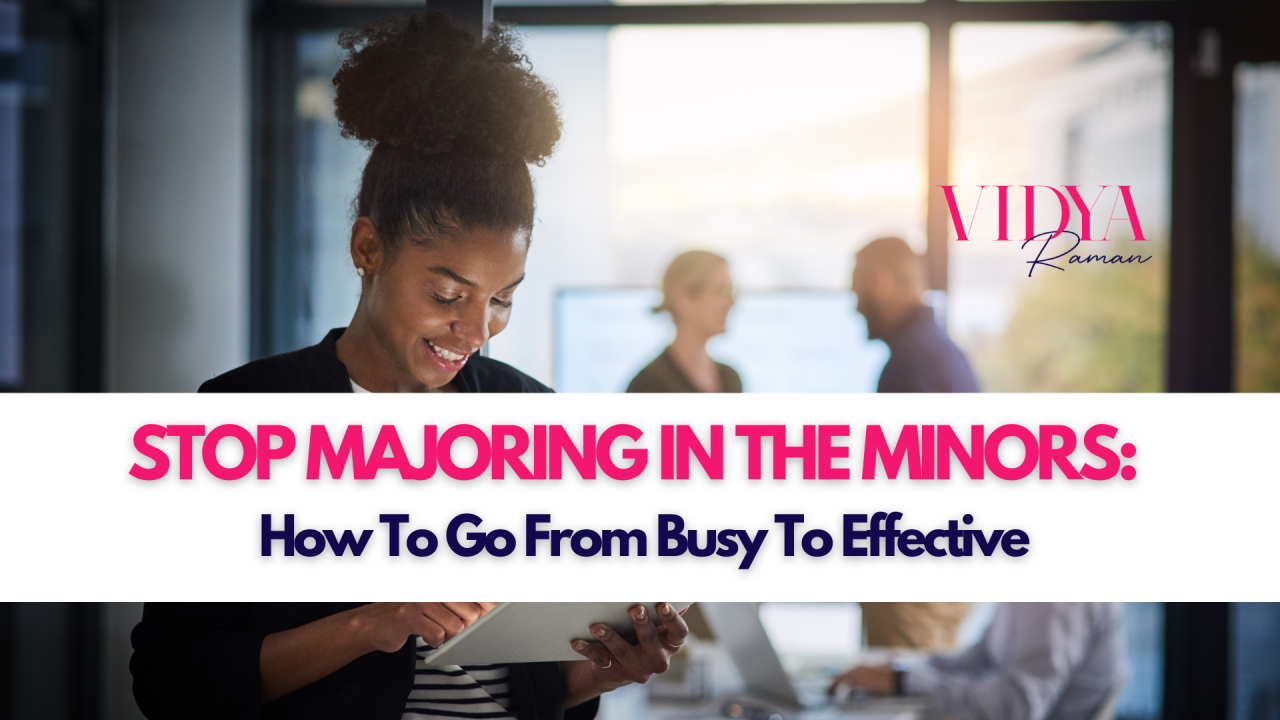
Introduction We all have ambitions and aspirations, and no one—and I mean no one—wants to look back on their life with regret, wondering why they didn't reach their full potential. Yet, why do so many of us feel like we’re not making the progress we hoped for? We’re busy, but are we really moving the needle forward? There are essential elements like self-awareness, emotional regulation, and courage that help us move forward, but often we miss the most important factor: time. Time is our most valuable resource, and how we use it determines our success. If we’re not careful, we can spend our days just running in circles, without getting any closer to our goals. The real question is, are we using that time effectively? In today’s world, busyness has become a badge of honor—a crutch we lean on to avoid facing what truly matters. We’ve turned a packed schedule into a sign of success, but in reality, it’s often just a defense mechanism, an excuse to distract ourselves from our deeply buried daunting mission. But when we do this, we’re essentially saying that our long-term goals don’t matter as much as our daily tasks. In other words, we find ourselves “Majoring in the Minors” every single day. Zig Ziglar once said, “It’s not a lack of time but a lack of direction. We all have 24 hours in a day.” Understanding Prioritization Prioritization is more than just a buzzword; it's a fundamental shift in how we approach our work and lives. Consider the classic analogy of trying to fill a jar with big rocks, pebbles, and sand. If you start with the sand—the minor tasks—you’ll never fit everything in. But when you start with the big rocks—your most important tasks—everything else falls into place. Your effectiveness not only aids your ambitions but also benefits the company you work for. It’s a win-win all around. The Cost of Majoring in the Minors Reflect on your typical workday. How much time is spent on emails, minor administrative tasks, or attending non-essential meetings? These are the “minors”—tasks that are necessary but not transformative. While they are part of your role, if you focus solely on these day-to-day activities, you risk neglecting the big picture, stalling your professional growth, and missing opportunities that could propel you forward. As a professional speaker, I often conduct polls during my talks to understand how many in the audience have a defined morning routine that sets the day’s agenda and intentions versus those who jump straight into responding to emails first thing in the morning. The latter group almost always dominates. But starting your work day without clear priorities is like running a corporate project without a plan. So, why approach your professional growth without a defined strategy? I invite you to watch my 1-minute YouTube video below Prioritization is not just about time management—it’s about managing your focus and energy to align with your most significant goals. Steps to Effective Prioritization Identify Your Goals: Start by getting crystal clear on what you want to achieve. Do you want to be recognized as a powerful communicator? Do you want your words to have a lasting impact? Do you want to showcase your talents in a meaningful and thoughtful way? Ask yourself what specific actions you can take to enhance your communication and influence. Make these actions a priority in your daily and weekly schedule. Invest time in reading relevant books, working with a coach, and practicing consistently in real-life situations. Evaluate Your Tasks: Review your to-do list with a critical eye. Identify which tasks will make the most significant impact on your goals. Prioritize those tasks first to ensure your efforts are aligned with what truly matters. Focus on High-Impact Activities: Concentrate your time and energy on tasks that drive results. For example, rather than spending hours perfecting the font on a presentation, focus on its content and how it will resonate with your audience. The substance of your work is what will make the difference. Learn to Automate and Delegate: If you find yourself repeatedly spending 2-3 hours each day on the same issues, consider whether these problems can be fixed permanently or automated. Addressing these solutions now will save you valuable time in the future for more high-impact activities. Additionally, recognize that you don't have to do everything yourself. Delegate tasks that others can handle and may even enjoy, freeing up your time for more critical work. Set Boundaries: Protect your time fiercely. Learn to say no to unnecessary meetings and avoid distractions that steer you away from your goals. Setting clear boundaries ensures that your time is spent on what truly matters. Conclusion Productivity isn't about doing more; it's about focusing on what truly matters. It’s not about being busy; it’s about being effective. So, take a moment today to ask yourself: "Am I majoring in the minors?" If the answer is yes, it's time to refocus. How do you ensure you’re focusing on what matters most? Share your thoughts in the comments below, and let’s learn from each other to boost our productivity together! Please don't forget to subscribe to this "Vision to Victory" newsletter, specially curated for corporate professionals like you, and share it with anyone who could benefit. I am deeply grateful. Stay Focused, Stay Purposeful, and Create Your Success! Warm regards, Vidya Raman, Motivational Speaker, Coach, Author, and ex-Corporate Leader Career advancement - Professional Growth - Communication Skills - Time Management - Priority Management
By Vidya Raman December 10, 2025
Introduction: Ever been in the middle of an important presentation, only to notice the glazed-over eyes of your colleagues? You’re talking, but are they really listening? Maybe they’re checking their phones or, worse, looking completely disengaged. It happens more often than we think. Whether you're presenting to your team, leading a meeting, or even having a one-on-one, losing your audience is a common workplace challenge. Attention is fleeting these days, and if you can’t capture and keep it, your message won’t land. If no one is paying attention, your career progression stalls. So, how do you keep your audience engaged? Let’s dive in. The following three actionable strategies are what I emphasize most with my coaching clients. 1. Have A Clear Agenda - Know Your Goal 🎯 How can your audience stay with you if you don’t know where you’re headed? Every conversation, presentation, or email needs a clear objective. Just remember all those precious hours wasted in directionless meetings, and commit to never being the one to contribute to that unfortunate reality of corporate life. Without a defined goal, your message can easily lose focus, and your audience’s attention will drift. Before you speak or write, ask yourself: What outcome do I want? Whether you're pitching an idea to leadership or aligning your team on next steps, knowing your goal helps you stay focused and makes your communication more impactful. 2. Know Your Audience - What Do They Want 👥 Tailoring your message saves everyone time and lowers frustration. Effective communicators always think about their audience first. In the workplace, this means understanding their needs, challenges, and knowledge level. If you tailor your message to what matters to your audience, they’ll stay engaged—because everyone’s tuned into the same station: WIIFM—What’s In It For Me. Are you speaking to technical experts or business leaders? If you’ve ever been irritated by unnecessary data, acronyms, and jargon, you know how quickly an audience can disengage. Before you speak or write, ask yourself: Do they need detailed data or just a high-level overview? The more you know about your audience, the better you can craft a message that resonates and keeps them engaged. 3. Know How to Structure Your Communication 🗣️ The human brain craves order and logical flow. Without structure, your message can feel scattered and confusing, making it harder for your audience to stay focused. A well-structured conversation or presentation is easier to follow, ensuring your key points land where they should. As Albert Einstein famously said, “If you can't explain it simply, you don't understand it well enough.” Keeping things simple and organized ensures that your audience will stay with you from start to finish. Here are some popular structures you can use: Problem-Solution: Present a problem or challenge first, then provide your solution or recommendation. STAR Method (Situation, Task, Action, Result): Describe the situation, explain the task at hand, outline the actions taken, and end with the result. Cause and Effect: Explain the cause of a problem or situation, followed by its effects or outcomes. And there are many more you can explore. Slow Down and Be Present You may argue that not every conversation can be perfectly planned. We’ve all found ourselves in situations where the words coming out of our mouths don’t align with what we’re thinking. Yikes! Factors like nerves, overthinking, or lack of clarity can lead to unfortunate rambling. Essentially, your brain processes thoughts faster than your mouth can keep up, leading you to stray into various tangents and ultimately deliver an unpolished message. Clear communication requires slowing down to organize your thoughts. Being present in the moment also helps with the tone you use because how you say something guarantees connection. If you're ready to master this art, I invite you to watch my 1-minute YouTube video and subscribe for more content like this. Keep it Simple and Make Your Message Matter! Warm regards, Vidya Raman Communication Skills - Presentation Mastery - Career Advancement - Professional Growth
By Vidya Raman December 9, 2025
How many times have you been in the shower when, suddenly, an idea strikes? It’s brilliant, unexpected, and exactly what you needed. Why does this happen in the shower, of all places? Because it’s one of the rare moments when you’re unplugged, surrounded by quiet, and free from distractions vying for your attention. The Gift of Quiet: More Than Relaxation As the year winds down, the final two weeks of December are often a blur of parties, last-minute work deadlines, and holiday planning that includes frantic shopping and gift wrapping. You may have checked off items on your shopping list for others, but have you considered giving yourself a gift that is truly meaningful and impactful? The Gift of Quiet. Use these two weeks to steal moments for yourself—time to quiet the noise, reflect, and intentionally prepare for a fulfilling year ahead. “Almost everything will work again if you unplug it for a few minutes, including you.” — Anne Lamott The Gift of Quiet isn’t just about relaxation; it’s about: Unlocking your best ideas Finding clarity Setting yourself up for success How I Reclaimed My Power During a period of career stagnation and frustration, I felt completely stuck, and hopeless. Out of sheer desperation and necessity, I quietly and purposefully distanced myself from noise and negativity. The status quo was untenable. Feeling hopelessly stuck was a signal to change my habits and practices. I embraced solitude and mindfulness. It was a pause to recalibrate and turn self-pity into self-power. I leaned into quiet practices—journaling to unravel my fears and rewrite my story, and long walks to untangle my thoughts and find clarity. In the stillness of solitude, I learned to observe and listen to my inner voice. These moments of quiet became the foundation for transforming stagnation into unstoppable momentum. If you're feeling stressed, lost, or confused now, there is no better remedy than The Gift of Quiet. Let’s explore how solitude, long walks, and a digital detox can help calm your mind, ignite creativity, and create a clear path to your goals. The Gift of Quiet is one that will keep on giving. Quiet Time vs. Constant Consumption Have you ever stopped to think about how little time you truly spend with your own thoughts? In a world that demands constant attention, we rarely pause to let our minds wander. Instead, we fill every spare moment with: Cheap laughs on Instagram Endless doomscrolling Consuming yet another video that adds little value Do you agree that our mindless consumption habits have kept us locked out of our best ideas? While these quick distractions offer a fleeting escape, they crowd out something far more precious: the space to source your own inner brilliance. Yet it’s in those quiet, unstructured moments—like a long walk in the park or a few tech-free minutes at the start of your day—that ideas take root. Your ideas are your differentiator! Journaling: Your Inner Compass Solitude doesn’t mean isolation—it’s about carving out moments where you can tune out the external noise and tune into your inner voice. Think of it as pressing the reset button for your mind. During these moments, whether it’s journaling your thoughts or simply sitting quietly, your brain shifts from reacting to reflecting. This is when clarity emerges. Journaling, in particular, is a powerful practice for untangling the thoughts swirling in your mind. It’s more than simply jotting down what happened in your day—it’s a way to ask yourself the difficult questions you might otherwise avoid: What am I afraid of? What’s truly holding me back? What do I want to create, change, or experience in the coming year? Writing your answers allows you to explore these questions deeply and without judgment. Benefits of Journaling: Identifies patterns in your thinking Highlights habits that no longer serve you Illuminates relationships or commitments that drain your energy Helps you transform abstract ideas into actionable steps The beauty of journaling is that it provides clarity in the face of uncertainty. It’s a space where you can reflect, dream, and strategize. Solitude is where vision meets focus, transforming your aspirations into tangible plans. “Imagination is more important than knowledge.” — Albert Einstein The Year Ahead Starts Now As we approach the close of another year, the noise around us can feel overwhelming. But by gifting yourself moments of quiet, you’re not just stepping away from the chaos—you’re stepping toward clarity, creativity, and confidence. Whether it’s a walk without your phone, journaling with intention, or setting aside an hour of tech-free time each day, these small but powerful actions set the tone for 2026. They help you craft a vision rooted in self-awareness and turn it into a roadmap for success. Interruptions, complications, and failures will inevitably come, but a calm, reflective mind is better equipped to handle them. The Gift of Quiet isn’t a luxury; it’s a necessity—one that will serve you long after the holiday decorations are packed away. So, as you prepare to step into the new year, remember: the most meaningful gift you can give yourself isn’t found under the tree. It’s the space to think, dream, and create—a gift that will keep giving all year long. Make it a daily practice. Quiet Leads to Breakthroughs—Make Sure You Listen! Warm regards, Vidya Raman, Career Growth - Career Advancement - Professional Growth - Presentation Mastery - Communication Skills - Interview Skills
By Vidya Raman December 9, 2025
Have you ever turned around at the sound of a stranger’s voice, captivated by its distinct tone and energy? These are the people with presence—those who don’t just speak but resonate. There’s a unique quality and strength to how they sound that commands attention and respect. Often, it’s not just what is said, but how it’s said. Your tone, pacing, and emphasis can make the difference between being overlooked or unforgettable. On the other hand, if how you sound comes across as monotonous, hesitant, or unclear, it can unintentionally diminish your message—and even your perceived value—no matter how brilliant your ideas are. Have you ever shared a great idea in a meeting, only to have it dismissed or ignored—until someone else rephrased it moments later and received all the praise? It’s frustrating, disheartening, and all too common. More often than not, the issue isn’t what you say but how you say it. To make 2026 your most meaningful and transformative year yet, focus on one of the most overlooked tools of success: how you sound in conversations and meetings. Not just the content of your ideas, but the strength, clarity, and impact of your voice. This is how your words carry weight and how you can own the room with presence and influence. The way you sound is what makes you uniquely you. For me, it was my uncommon and unusual accent. What I initially perceived as a weakness, I transformed into my strength. And you can, too. It’s not about changing who you are—it’s about refining how you’re heard. Its about making yourself memorable. How to Strengthen How You Sound Your voice is more than just a tool for communication—it’s a bridge to influence and impact. Follow these steps to refine your voice and make your presence felt in every room you enter: 1. Master Your Tonality: It's Not Just What You Say Your tone can change the entire perception of your message. A warm, confident tone invites trust, while a flat or rushed delivery can signal uncertainty. Feel Your Words: Eliminate rigid professionalism and immediately become more interesting. Feel the words coming out of your mouth and immediately see your connections blossom because others immediately feel your warmth and sincerity. Influence and impact can never be accomplished with a robotic presence. Practice Varying Your Tone: Record yourself reading aloud. Notice if your tone fluctuates or stays flat. Experiment with adding more energy or warmth in key parts. Emphasize Key Points: Pause for impact or slow down to highlight important ideas. This signals confidence and draws attention to your message. 2. Build Confidence in Your Delivery Confidence is contagious. If you don’t sound convinced by your own words, it’s hard for others to believe you. Breathe Before You Speak: Nervousness often causes a shaky or rushed voice. Take a deep breath to ground yourself before you start. Speak Up: Volume conveys authority. Practice projecting your voice so it’s strong but not overpowering. 3. Avoid Common Pitfalls: Monotony and Hesitation A low-volume, monotonous, or hesitant voice can quickly lose your audience’s attention. Raise Your Volume: If you tend to speak too softly, aim to increase your volume by a couple of levels. On a scale from 1 to 10, move from a 3 to a 7 and observe the difference. Singing loudly in the shower can be a fun and effective way to practice. Break Monotony: Use changes in speed, pitch, and volume to keep listeners engaged. Eliminate Fillers: Replace “um,” “uh,” or “like” with silence—it shows composure and confidence. 4. Align Your Words with Your Body Language Your words and body language work together to create impact. People lean on and trust non-verbal cues. Ensure that it is aligned with your words. Posture: Stand tall or sit upright to project confidence. Gestures: Use purposeful gestures to emphasize key points without overdoing it. 5. Seek Feedback and Keep Practicing Improving how you sound isn’t a one-time fix—it’s a continuous process. Ask for Feedback: Record your meetings or ask a trusted friend or colleague to evaluate how you sound. Join Groups: Organizations like Toastmasters provide a safe space to refine your speaking skills. 6. Seek Coaching from Experts As a professional speaker, certified coach, and former corporate leader, I offer personalized one-on-one coaching through my Career Advancement and Executive Presence Program. Designed to help you amplify your influence, this program delivers unmatched value. Checkout my programs at : https://www.vidyaraman.com/coaching . Final Thought: Your voice is your calling card—it’s how you present yourself to the world. By refining how you sound, you can command attention, amplify your ideas, and build a presence that ensures your voice is not only heard but respected. Make 2026 the year you master this powerful tool and unlock new levels of influence and success. Speak boldly, inspire greatly, and make your message matter! Warm regards, Vidya Raman, Professional Speaker, Coach, Author, and former Corporate Leader
By Vidya Raman December 9, 2025
In my keynote, Master Connections, Master Your Career, I emphasize one simple truth: the strongest connectors aren’t always the most extroverted, the loudest, or the most charismatic. They are the ones who exude confidence and make others feel comfortable. And do you know what makes that easier? Being comfortable in your own skin. Breaking the ice takes confidence. Small talk requires ease. Navigating conversations in unscripted situations demands self-assurance. And one of the simplest ways to gain that confidence? How you present yourself. When you’re groomed and dressed well, you don’t think about how you look—you focus on the person in front of you. You engage. You connect. Your Clothes Are Talking—What Are They Saying? Have you ever noticed how you feel when you put on your best outfit? The crisp blazer, the perfectly polished shoes, the confident stride that naturally follows? That’s Enclothed Cognition in action—the psychological effect where what you wear influences not only how others see you but also how you see yourself. The Science Behind It A study by Northwestern University found that participants wearing a white lab coat—believed to belong to a doctor—performed significantly better on attention-related tasks than those wearing ordinary clothing. However, when the same coat was described as belonging to a painter, the performance boost disappeared. The takeaway? What you wear isn’t just fabric—it’s a signal that shapes behavior, perception, and even performance. The Unspoken Rules of Professional Presence Imagine two professionals walk into a meeting—one dressed sharply in polished attire, the other in a casual, wrinkled shirt. Who do you assume is more competent? Fair or not, people judge credibility, authority, and attention to detail based on appearance. But it’s not just about impressing others. Dressing intentionally primes your brain for success, boosting confidence and making you feel more in control. A lawyer in a power suit, a CEO in a structured blazer, or even a remote worker who swaps pajamas for smart-casual attire—all experience an internal shift in confidence, focus, and productivity. Even in the era of Zoom meetings, how you dress affects your posture, tone, and overall engagement. The way you present yourself, even virtually, shapes how you show up in conversations and how seriously you are taken. A Missed Opportunity Think about a time when you avoided engaging with a neighbor or a stranger at the grocery store because you weren’t comfortable with how you looked that day. Maybe you ran out to grab the mail in mismatched clothes and suddenly saw someone you knew—but instead of stopping for a chat, you hurried inside. That hesitation, that moment of self-consciousness, is Enclothed Cognition in action. A fleeting moment of self-doubt led to a lost opportunity—not because of a lack of interest but because of how you felt about your appearance. What Dressing Appropriately Can Do for You Dressing well doesn’t just change how others perceive you—it instantly shifts your own mindset. The moment you put on polished, well-fitted clothing, you stand taller, speak with more authority, and feel a heightened sense of readiness. Studies have shown that people who dress professionally experience an immediate boost in confidence, motivation, and decision-making ability. And the best part? It takes just 15 minutes. A simple grooming routine eliminates self-doubt and frees you to fully engage, connect, and focus on what matters. Instead of worrying about your appearance, you’ll have the mental bandwidth to speak up, step forward, and create opportunities. Dressing for the Role You Want It’s tempting to downplay clothing, especially in today’s more relaxed work environments. But ask yourself: Do your clothes reflect the level of professionalism, leadership, or ambition you want to project? If you were to share an elevator with a senior executive at work, would your outfit make you feel self-assured or self-conscious? The goal isn’t to chase trends or wear expensive brands— it’s to align your appearance with your aspirations. If you desire connection and influence, maintaining your appearance allows you to connect, converse, and create a network. The payoff in networking and relationships is immense. The more confident you feel, the more likely you are to initiate conversations, build collaborations, and leave a lasting impression. The Bottom Line Every time you get dressed, you’re making a choice about how you want to show up in the world. A simple 15-minute effort in grooming and dressing well can set the tone for your entire day. The payoff is huge. Use enclothed cognition to your advantage: Dress in a way that not only earns respect but also reinforces the version of yourself you want to become. Become a master connector by eliminating self-doubt and seizing every unscripted opportunity to grow your network. Can you spare 15 minutes to look your best? At Vidya Raman Leadership Programs , I help professionals sharpen their communication, strengthen their connections, and amplify their influence. If you’re a business leader or leader of an association( Sales, Project Management, Human Resources, Technology, Healthcare, Hospitality, and more) and ready to elevate your team’s impact, let’s connect. Your presence is your power. Make it work for you. Warm regards, Vidya Raman, Professional Speaker, Coach, Author, and former Corporate Leader Career Growth - Career Advancement - Professional Growth - Presentation Mastery - Communication Skills - Interview Skills
By Vidya Raman December 9, 2025
Finding a Parking Spot... and Other "Lucky" Moments You pull into a packed parking lot during the busy Christmas shopping season, and somehow, miraculously, a spot opens up right in front of your favorite department store. “Today is my lucky day!” you squeal with delight. That’s dumb luck. The kind you can’t plan for, predict, or influence. It’s nice when it happens, but you can’t build a strategy around it. Most of us attribute all unexpected wins to chance. Someone’s success? Oh, they just got lucky. But is that really the whole story? What if luck, especially at work, isn’t just about rolling the dice? What if some of it could be cultivated? Let’s break it down using Dr. James Austin’s four types of luck. Each one shows up at work in ways that are both subtle and powerful, if you know what to look for. 1. Blind Luck (The Lightning Strike) This is pure randomness, like that parking spot you didn’t expect to find. It’s the project lead role that unexpectedly lands in your lap because the current project manager quits without notice. You were in the right place at the right time. “Fortune brings in some boats that are not steered.” — William Shakespeare Yes, it’s nice when it happens. But it’s not a strategy. You can’t count on it. You can only be ready to recognize it when it shows up. 2. Luck from Motion (The Door Opener) This kind of luck shows up when you’re already in motion, engaged, and executing on a professional growth path. You invest in your communication skills: public speaking, interpersonal effectiveness, active listening. You take on stretch assignments, build relationships, and focus on making authentic connections. You plant seeds regularly and consistently. Some grow. With every action, you begin to build a personal brand, slowly and methodically. Many of your peers don’t notice the subtle changes, but leadership does. One day, you’re tapped to lead a major initiative tied to the company’s new direction. Your peers are stunned. People often say, “Wow, they got lucky overnight.” But as Denzel Washington once said: “I say luck is when an opportunity comes along and you're prepared for it.” The myth of overnight success hides the truth. A strong execution that supports a clear vision matters. Consistent action matters. You don’t stumble into opportunity while sitting still. The visibility you create by showing up again and again lays the foundation for the so-called lucky break. 3. Luck from Awareness (The Opportunity Spotter) This luck comes to those who are paying attention. Keen observers sense what others overlook. Let’s say you hear your manager casually reference a gap in the perception of her team’s effectiveness. She mentions a tool that could help showcase the team's impact to her senior leaders. She doesn’t linger on it and quickly moves on to the next agenda item. Others in the room ignore it, assuming it’s just an aside. But you stay curious. You research the tool, sketch out a few ideas, and even build a prototype to share with your manager. She’s beyond impressed. Why? Because you picked up on what wasn’t expressly stated and you offered a solution before the ask. You made her look good, and with that, you positioned yourself for greater visibility and your next lucky break. That’s not an accident. That’s strategic awareness. Noticing what’s left unsaid—tone shifts, timing, hesitation—can make a real difference. Knowing when to speak up, when to ask, and when to hold back is a skill. It’s a quiet leadership trait that decision-makers notice. “It’s not what you look at that matters, it’s what you see.” — Henry David Thoreau Being present and paying attention is a superpower. I speak about this often in my keynote, “Read the Room: Better Observation Skills for Greater Impact at Work.” If you’re not tuned in, you’ll miss the moment. The better you get at reading between the lines, the more visible those hidden opportunities become. 4. Luck from Uniqueness (The Personal Magnet) This is the kind of luck that finds you because of who you are, not necessarily just what you do. It comes from your unique mix of skills, personality, and passions—even the ones that don’t seem related to your job. Maybe you’re an actuary who tells great stories. Or a software developer with a strong eye for design. These unexpected combinations make you stand out and attract opportunities others don’t see. You might be pursuing hobbies that light you up—photography, improv, coaching—and one day, those interests show up in a pitch or client conversation. That so-called “side interest” becomes your secret edge. Your individuality becomes the Luck magnet. The more you lean into what makes you different, the more the right opportunities seem to find you. “Always remember that you are absolutely unique. Just like everyone else.” — Margaret Mead Uniqueness isn’t about being loud or flashy. It’s about being fully and genuinely yourself. That’s when the right kind of luck starts showing up. So What’s Luck Got to Do With It? Everything. But not in the way most people think. You can’t control every lucky break. But you can become the kind of professional who: Takes intentional action Pays attention to unspoken cues Develops a distinct edge Says yes before feeling fully ready That’s the real formula. This is the heart of my book, 𝐋𝐮𝐜𝐤𝐲 𝐘𝐨𝐮: 𝐀𝐧 𝐈𝐧𝐬𝐢𝐝𝐞𝐫'𝐬 𝐆𝐮𝐢𝐝𝐞 𝐓𝐨 𝐀𝐜𝐡𝐢𝐞𝐯𝐢𝐧𝐠 𝐒𝐮𝐜𝐜𝐞𝐬𝐬 𝐚𝐧𝐝 𝐅𝐢𝐧𝐝𝐢𝐧𝐠 𝐅𝐮𝐥𝐟𝐢𝐥𝐥𝐦𝐞𝐧𝐭 𝐈𝐧 𝐓𝐡𝐞 𝐂𝐨𝐫𝐩𝐨𝐫𝐚𝐭𝐞 𝐖𝐨𝐫𝐥𝐝 , where I walk you through the S.H.I.F.T. framework to build awareness, act with courage, and open doors others don’t even see. How are you creating your next lucky break? Let’s talk about it. If you haven't read my prior "Vision To Victory" editions, I strongly encourage you to do so. It may just help you land your next lucky break. - Subscribe on LinkedIn https://www.linkedin.com/build-relation/newsletter-follow?entityUrn=7214611117371703296 Warm regards, Vidya Raman Career Growth - Career Advancement - Professional Growth - Communication Skills - Presentation Mastery - Interview Skills

By Vidya Raman December 9, 2025
The first four months of 2025 have felt like a storm. Layoffs. Hiring freezes. Looming AI changes and the growing buzz around AGI. The steady drumbeat of marketplace change has left many focused professionals feeling distracted and stressed. Even top performers are left asking, What more can I do to survive this scary and seemingly dark shift? If you’ve been walking into work with a sense of purpose, managing tricky relationships, and delivering results, yet still feel uneasy, you are not alone. In times like these, strong performance alone doesn’t always guarantee job security. That’s exactly why this moment matters. As a career coach, I’ve worked with professionals navigating these uncertain seasons, helping them strengthen their presence, reframe their value, and walk into opportunities with clarity and confidence. It’s the opportunity to pause, reflect, and reconnect with the version of you that can withstand the onslaught of chaos and change. A clarion call for reflection, not retreat. "You may not control all the events that happen to you, but you can decide not to be reduced by them." — Maya Angelou At nearly every conference I’ve spoken at since spring 2024, the agenda has been packed with AI deep dives, prompt engineering, and automation workshops. It’s a smart starting point. We should all understand and adapt to how AI is reshaping our industries, but it’s not a cure-all. AI may inform the work, but it doesn’t replace what makes you irreplaceable. Soft skills—like emotional intelligence, communication, judgment, and adaptability—aren’t just nice to have. They’re your competitive edge. In a world where data is everywhere, discernment is rare. What Can You Do When the World Feels Wobbly? 1. Protect your energy before managing your output. When the world feels wobbly, most people double down on productivity. They fill their calendars, push harder, and try to outrun the stress. But professionals with staying power know that energy, not just effort, is their most valuable resource. Managing your energy is not about bubble baths or burnout recovery. It’s about intentional habits that help you reset and return to yourself before the world pulls you in every direction. Whether it’s a quiet morning routine, stepping away from back-to-back meetings, or building in space between tasks, small shifts create the margin you need to think clearly and show up fully. These habits are not just personal. They’re strategic. When you’re grounded, you communicate better. You listen with more patience. You make sharper decisions. In a time when everyone seems reactive, your steady presence becomes memorable. You don’t need to control everything around you. You just need to control how you walk into the room. 2. Redefine how you introduce yourself. Job seekers especially need to think beyond resumes and LinkedIn headlines. Interviews are not just about experience—they’re about perception. As a career coach, I’ve helped professionals refine their interview presence to communicate confidence, clarity, and authentic value under pressure. In high-stakes conversations, how others experience your presence, clarity, and confidence leaves a lasting impression. This is where your narrative becomes your differentiator. In times of change, the stories we tell about ourselves matter more than ever. Yet most professionals default to job titles, departments, or past projects when asked what they do. That’s fine on paper, but it doesn’t capture your essence or your impact. Now is the time to revisit your narrative. If your title disappeared tomorrow, how would you describe your value? What problems do you solve? What patterns do you spot? What strengths do people consistently rely on you for? Start shaping your answer around outcomes and identity, not just tasks. Instead of saying, “I manage operations,” try, “I create systems that help teams deliver with less friction.” Instead of “I’m in HR,” try “I help leaders build environments where people want to stay and grow.” When you own your story, you show up differently. You speak with clarity. You introduce yourself with purpose. You become known not just for what you do, but for how you think. 3. Lead, even without the title. You don’t need a new role to lead. You just need to start showing up like someone who can be trusted with more. In uncertain times, people gravitate toward those who bring clarity, not chaos. Step up in small ways: recap key takeaways after meetings, offer support to colleagues, or raise thoughtful questions that help the team see the bigger picture. Leadership is not a position. It’s a posture. And when you show others that you can stay steady, think critically, and bring people together, new opportunities will begin to find you, even before you go looking for them. Your Edge in an Unsteady World New tools, platforms, and systems will keep evolving—and yes, it’s smart to stay current. Learn them. Use them. But don’t confuse tools with transformation. In a crowded, competitive workplace, what truly sets you apart is how others perceive your competence, your credibility, and your value. That’s why these three moves matter. Protecting your energy helps you show up with intention. Redefining your narrative helps others understand your unique contribution. And leading without a title shapes how you're remembered when decisions are made behind closed doors. How others perceive you plays a critical role in whether you survive this storm. Perception shapes opportunity. And when you master what I call the Perception Trio—competence, credibility, and value—you position yourself not just to survive uncertain times, but to rise through them. Wishing you clarity, calm, and forward momentum. Warm regards, Vidya Raman Career Growth - Career Advancement - Professional Growth - Communication Skills - Presentation Mastery - Interview Skills
By Vidya Raman December 9, 2025
You work hard. You exceed expectations. You take ownership, deliver results, and bring forward ideas others might never see. Yet sometimes, your brilliance does not earn applause. Instead, it is met with silence, side glances, or quiet resistance. What’s going on? This isn’t corporate paranoia. It is a well-known workplace pattern called Tall Poppy Syndrome. The idea is simple. When one poppy grows taller than the rest, it is often the first to be cut down. Not because it did anything wrong. Simply because it stood out. If you have ever been called or perceived as “too ambitious” or “too assertive,” or told you are “making others uncomfortable” when all you are doing is delivering excellence with integrity, you are not imagining things. Sometimes, your detractors may unfairly label you a “Roadblock” simply because you dared to ask, “Are we sure this is the best path forward?” The truth may be that you are a roadblock to someone’s shortcut path to Senior Vice President. Oops. 😄 But this is not a reason to get cynical or assume the worst about everyone. It is not an excuse to dismiss feedback or blame others for every challenge. Some resistance is healthy. It helps us grow. But if the pattern keeps repeating, if your competence draws more discomfort than encouragement, it is worth noticing. What I See in My Career Coaching Practice Many of my clients share this frustration. They are struggling because of how their performance is unfairly perceived. People often praise and support those who are agreeable and non-threatening. It is human nature. It is the same reason why a weak post on social media gets a hundred likes, while a bold or thought-provoking one makes people hesitate. Visibility feels safer when it doesn’t challenge the status quo. How Do You Know If You Are a Tall Poppy Being Quietly Cut Down? Here are some common signs: You are excluded from meetings you once attended. Decisions are made without your input, even on projects you lead. Your ideas are ignored until someone else presents them. You notice distancing through body language, less eye contact and less engagement. You are left off email threads where you were once looped in. You stop hearing about opportunities, stretch projects, or leadership visibility moments. You are given feedback to “be less direct” or “tone it down” even when you are delivering facts with professionalism. Your wins are not being shared. Your name is not being mentioned. People may start calling you “difficult” or “challenging,” not because of your behavior but because of your results. What Can You Do When Your Excellence Is Met With Resistance? First, do not retreat in an obvious way. Do not overcorrect by going silent. Hold your space. Stay present. Do not shrink. Then step back quietly. Not in defeat, but to strategize your next smart move. Standing out becomes risky when it threatens relationships, especially with people who hold influence. Your competence needs to walk alongside emotional intelligence and warmth. That is what earns trust, not just results. How to Ensure Your Tall Poppy Does Not Stand Alone 1. Lead With Curiosity, Not Just Clarity Brilliance without warmth can intimidate. Make others feel seen. Invite their ideas. Ask thoughtful questions. Stay curious in conversations, not just certain. 2. Package Your Value as a Win-Win It is easy for high performers to be labeled as “competitive.” Reframe your success as something that benefits the whole. Saying, “I streamlined this so our team could stay ahead together” lands better than “I delivered ahead of schedule.” Subtle shifts matter. 3. Cultivate Visibility Without Ego Let people see the good work you do, but do not chase applause. Share your ideas openly. Give credit to others. Focus on building strong relationships, not just stacking achievements. When your visibility comes from contribution and connection, it is harder for others to resent. What Sets You Apart in a World That Sometimes Resists Excellence? Being brilliant is not enough. Being brilliant while building good relationships is what really sets you apart. Those who rise through complex environments know this truth. You do not grow tall alone. You grow tall alongside others with roots of trust, curiosity, and collaboration holding you steady. That is how you protect your momentum and your future. Your Action Step This Month Reflect on this question. How can I package my excellence as an invitation, not a threat? The answer might just unlock your next level of influence. Wishing you strategic growth and meaningful connections. Warm regards, Vidya Raman  Career Growth - Professional Growth - Career Advancement - Presentation Mastery - Communication Skills - Interview Skills